December 6 - 10, 2018
Holy crap! It's only 19 days until Christmas!
But I'm already digressing...
Holy crap! I was supposed to post this review on Sunday, December 2, and now it's Thursday, four days later [NOTE: Maybe even Monday, December 10th... and 15 shopping days left!] and I'm still working on the review..!
But, what else is new...
Welcome back to yet another episode of the so-called Netflix Connection! Originally, what I called (and, uh, only I refer to as) the "Netflix Connection" is a series of movie reviews that I wrote this year based on movies that I watched with horror bloggers, Mermaid Heather and Zombie Dawn. Unfortunately, we don't watch the movies all together in the same room (ooh... wouldn't that be cozy...) due to geographical circumstances (Hey! At least the internet is good for something, hahaha!). Usually we pick a film showing on Netflix (hence and etc.), but this time Heather had the inspired idea to suggest a film that was being made by filmmaker Scott Schirmer who had a Kickstarter campaign going on at the time for his latest horror feature, THE BAD MAN. So we three horror film musketeers agreed to contribute to the campaign and watch the film when it was released. And it has been and here we are! Yay!
Now, Heather's choice of THE BAD MAN wasn't arbitrary. It features Ellie Church, who's been in a number of low-budget independent films since she became an actress around 2013. In the last five years she's racked up 24 acting credits (so far), according to IMDb. Heather has me beat in how many Ellie Church films she's seen, although I can still say I've seen MANIA and Heather still hasn't. With Heather's assistance (because she's awesome!) and also on my own, I've managed to accumulate a decent collection of those films on DVD or Blu-ray: TIME TO KILL, HEADLESS, HARVEST LAKE, FRANKENSTEIN CREATED BIKERS, PITFIRE OF HELL, PLANK FACE, SPACE BABES FROM OUTER SPACE, DEAD BODIES IN #223, and now, THE BAD MAN.
However, besides our fascination/unhealthy obsession with Ellie Church, THE BAD MAN also re-connects us with the filmmakers behind HEADLESS which I not only have the DVD for, but I also saw it (!) AND wrote a review (!!). I'm telling you, the universe is sometimes crazy and unpredictable.
Anyway, enough bla bla bla... on to THIS review, shall we?
THE BAD MAN (2018, Written and directed by Scott Schirmer, with Ellie Church, Arthur Cullipher, Jason Crowe, and Dave Parker)
Mary (Ellie Church) and PJ (Jason Crowe) have inherited a bed and breakfast from Mary's grandmother, Ginny, who recently passed away. The couple have just arrived at the establishment to settle in, hoping to take a few days to re-group from the sad event and also to prepare for a new direction in their life. Also, they're looking forward to some time just being alone together. Unfortunately, those plans are going to be seriously derailed...
Only a few minutes after having arrived themselves, they hear a knock at the door. Puzzled, Mary says she cancelled all the reservations. They go to find a man waiting in the front hallway, Lawrence (Arthur Cullipher). Mary explains the circumstances of the death of the B&B's owner and that she tried to notify everyone that reservations for the weekend were cancelled. Lawrence didn't get the message but he totally understands the situation and he goes to leave, offering his condolences and asking if there's another hotel nearby.
He also mentions what a nice lady Ginny was and that catches Mary's attention. Because Lawrence knew Ginny from previous visits to the house, Mary has a change of heart and invites Lawrence to stay, especially since he's only staying overnight.
In private, PJ's understandably disappointed because he was looking forward to being alone with Mary, but Mary says the distraction is good for her.
Horribly, Mary's kind change of heart will be rewarded with a non-stop descent into hell.
Lawrence will kidnap, restrain and psychologically separate the couple. His ulterior motives for coming to the place is actually to transform the two lovers into "products" for a sick and perverse clientele who are in the market for sex slaves, with the customers having very specific agendas. Specifically, Lawrence aims to transform Mary into a "living doll" and to re-program PJ into being a "dog" to be used by a human master for whatever sick purposes. To top things off, Lawrence does all this in full clown make-up.
So, yes. The premise for this film is pretty sick and twisted.
Also, if you're a genuine fan of clowns because of the joy and good feelings they bring to children and the world in general, well, for god's sake, don't watch this movie.*
The primary cast for this film is Mary, PJ, Lawrence and, in a non-speaking role, Charlie, Lawrence's perpetually topless, muscled henchman whose face we never really see because he constantly wears a gas mask with the long tube dangling elephant-like, a visual that'e either obscene or comical or both simultaneously. Though, Charlie doesn't say a word throughout the film, his gas mask occasionally utters these terrible sounds approximating unfortunate associations with flatulence. On paper that sounds funny, but you usually hear these inappropriate and embarrassing noises when Charlie's mistreating PJ, so the whole effect is genuinely disturbing.
The bulk of the film is watching Lawrence's efforts to prepare his two products for sale, and the final act is when Mary and PJ are brought to the auction and we see more weirdos as they bid on the cursed couple (along with other unfortunate living products). The high bidders will take home their purchases and do with them what they will in secret and for as long as they like.
What's terrifying and (also depressing) about this scenario is that it has to compete with the audience's knowledge of reality, to some degree. In the past, a horror movie usually had some fantastic horror element that was firmly in the realm of make-believe: the Frankenstein Monster, a vampire, a wolfman, a creature that lived underwater and could walk on land, etc. But with films like PSYCHO and THE TEXAS CHAINSAW MASSACRE, movie monsters started crossing into the demographic of... our own neighbors, people who look like you and I, but who harbor dark secrets. And now the horror films find "competition" with real life, like John Wayne Gacy who did charity work a clown but also lived a sinister secret life as a serial killer. Gacy is actually referred to in THE BAD MAN during a dinner conversation between Mary, PJ and Lawrence before the guest's true diabolical intentions are revealed. To refresh your memory, Gacy played "Pogo the Clown" at various charitable functions in a suburb of Chicago in the 70s, and, while doing that, he also had a surreptitious lifestyle where he sexually assaulted, tortured and killed at least 33 young men. Gacy also managed three KFC restaurants and was voted "outstanding vice-president" of the Waterloo (Illinois) Jaycees in 1967, the same year he committed his first sexual assault on a teenage boy. And this all actually happened.
Hell, even fictional zombies have to compete with real life.
That meta-discussion aside, THE BAD MAN does a nice job telling it's dark tale of two victims suddenly crossing paths with a sick side of society and how that particular society developed into a capitalist demographic. Writer/director Eli Roth's HOSTEL explores a similar idea, except in HOSTEL, the enterprise is kidnapping tourists and selling them to customers who want to kill and torture them in a safe environment. In THE BAD MAN, the customer is bidding on innocent people who have been programmed to be slaves to fulfill a specific sexual fetish. So, more of a specialty market in human trade. So, Schirmer's vision is either a pessimistic speculation of the world and where it can go, or THE BAD MAN is simply a glimpse 20 minutes into the future.
Ellie Church does a fine job here as the protagonist trying to survive her ordeal at the hands of Lawrence. Although she has her share of screaming and reacting in horror to the abuse her husband suffers and she herself has to endure, she also reveals a gentle, playful and loving dimension to her character when she's alone with PJ. Arthur Cullipher as Lawrence the Clown is a jarring combination of extremes: initially appearing as a kindly, arguably non-descript man with a kind face and polite and forgettably pleasant demeanor, he also reveals his believably disturbed and sadistic personality. Since Cullipher also directs and works SFX, I can't help but wonder what it's like working with him in real life on films when he's behind the scenes (cue nervous laughter).
The production values are quite good. It's sharply shot and I think what also enhances this independent film partially financed through Kickstarter are the props and production design that help depict this secret sinister world, like Lawrence's precise clown make-up, Mary dressed up as a doll, even the twisted scene when Lawrence wraps up part of Mary's body as a gift/punishment. The way her body is carefully packaged is a nice bizarre touch.
Also, as a product of a Kickstarter campaign, there were some cool extras that came with the limited edition Blu-ray I got (number 212 out of 450 copies):
The box's artwork features two designs: one cover's a photograph of Lawrence and the Doll, the other side is artwork which looks really great (I'll have to look up the artist);
One embroidered THE BAD MAN patch;
Six (6) autographed character cards;
A long sticker with individual photo portraits of the Doll, the Dog, the Clown and the Henchman;
Two (2), um, blank "product information" cards, one for a male, one for a female;
and
Two (2) wrapped lubricated latex condoms, each wrapper featuring a masked Dog logo saying, "Good Boys Wrap It Up!"
The Blu-ray package has 2 discs, one disc with the film, and the second has the 60 minute film, HOUSE OF HOPE, Scott Schirmer's first film PLUS 25 minutes of BONUS features.
A smartly designed little package!
If I have any criticism of the film, I think having the story bracketed by a television interview works against the telling of the story. Right from the start, this story is told in flashback as Mary tells what happened to her to a female TV reporter (who is unseen but we hear her asking questions). When I saw this as the set-up, I immediately wondered why do this? The implication is that whatever we're about to see from now on, we'll already know that Mary survives this, so it's kind of a spoiler. It removes a degree of tension, of suspense from the viewer right from the start. In fact, that idea is emphasized because the reporter describes Mary as a "survivor" as well. True, there are other elements to consider as the story continues, like what will happen to PJ, for instance. But still. And with this question of the narrative choice in my head already planted from the start, whenever we saw some of this interview throughout the film (it doesn't intrude often but it does come back) I felt none of it was necessary, it didn't really add to the story. But aside from this narrative decision, THE BAD MAN is an effective exploration into an unexpected, life-changing run-in with a practically invisible predatory element in our society.
Additional thoughts:
- THE CLOWN CONVERSATION AT DINNER: So, while they eat, Lawrence informs PJ and Mary that he also works as a clown. Mary confesses she's not a big fan of clowns and, to a certain degree, PJ agrees with her. So, there's a conversation where Lawrence is explaining the good he does as a clown and why he chose to do this and also the history of clowns before this bad rap became attached to clowns. And Mary and PJ keep coming up with examples, like Gacy, as to why they distrust clowns until Mary apologizes for being an "asshole." Of course, to be extremely simplistic and reductive, Mary's apology is sickeningly ironic: Lawrence will soon win the "asshole" title in spades. But, in hindsight, it's amusing that Lawrence's character seems to have compartmentalized his own behavior and attitudes so completely that he seems to be genuinely defensive during the conversation.
- SEXUAL ASSAULT AS PROGRAMMING: Okay, I confess. I took a peek at both Heather's and Dawn's reviews while I was still wrapping this review up. And Dawn understandably warns her readers about triggers for sexual assault as Lawrence's strategy to prepare Mary for what it will be like to be a living doll for a customer is essentially a regimen of varieties of rape. I understand this. She's going to be a sex slave, so she better get used to it. Although, really, I think Lawrence is just getting off on his own by doing this. Anyway, what I think is interesting is the idea of warning potential viewers of this story element, a practice that has grown over the past years. In movie ratings, for instance, it's stated if rape happens or is threatened in the film (along with drug use, etc.). I think this is a positive development. But, there's also another development over the years within the porn culture. Now, my knowledge of this is superficial, and I think I know just enough to get me into trouble, so my apologies if it turns out I'm over-simplifying the subject or even discussing it ignorantly. Anyway, I've heard that rape story-lines have been outlawed in porn films some years ago (I'm assuming after the 70s) and without researching it more, I wondered if there was some scandal where perhaps actual sexual assault was captured on camera and then sold as part of the film. In the era of so-called "roughies" I can imagine this scenario happening. But, now I see that there is a current porn genre where women (perhaps men, too) are subjected to gang assault and it's packaged like a rape fantasy for the actress. I have to confess to my personal shame and embarrassment that I've seen a few of these things, and I'm struck by not only the existence of this genre, but also the misogyny and barely restrained violence by the "assailants" toward the "victim" in some of these. And for the most part, the actresses seem to come out of it like they just accomplished some endurance test like a marathon or extreme rollercoaster. True, this is supposedly consensual and NOT everyone buys into this type of fantasy. I only bring it up because the subject matter of the film made me consider it. I guess my point is, the current culture in pornography now is such that you can be arguably be part of such a video and fairly easily, especially if you have a video camera and like-minded participants. What THE BAD MAN suggests is, even the most extreme behavior of sexual violence between participants isn't enough for some and that's simply because it IS consensual. For the buyers/consumers of this film's world, gratification comes only when you can have your way with someone and they DON'T want you to. The customers Lawrence deals with need to TAKE their pleasure from their products. And [SPOILER ALERT!] even then, one customer's gratification needs involve sex AND murder. It's, like, there's no pleasing these people! Also, transgressive behavior is already creeping into mainstream narratives. THE BAD MAN is labeled more of a genre film, but ROOM (2015) with an Oscar-winning performance by Brie Larsen is a drama, that tells of a woman captured by someone and kept as a sex slave and who raises her son in that environment. Like, to a certain degree, this terrible type of narrative is no longer that out of the ordinary. Just like serial killers like Gacy are no longer unique. Just like shooting sprees not only continue, but they have also "spread" from the schools to public venues. Just like... whatever horrible thing there is out there, it EXISTS and believe me, it'll soon be on the news. Tonight. People SUCK.
[NOTE: By the way, even though I brought up the subject of porn, that's mostly me free-associating. I wouldn't at all describe the filmmakers' telling of THE BAD MAN as nearly pornographic at all versus, let's say, stretches of THE BUNNY GAME, for instance. In fact, THE BAD MAN is almost restrained in its storytelling. In fact, I'll go further and say that a few certain moments I thought it could have indulged a bit in a more exploitative approach, but just saying that seems contradictory or hypocritical regarding responsible storytelling. Still... I'm saying it!]
- LAWRENCE'S ATTITUDE TOWARD MARY [SPOILER ALERT!]: This was an interesting final twist. Lawrence actually reveals he had feelings for Mary and makes a last minute bid (literally) to convince her to see him as a possible companion. He even begs, saying he'll change for her! This is so sad and pathetic. And messed up! I don't have anything really insightful to say, except this seems like a believable turn of events. People are so complicated. It's typical for people to avoid relationships because they've been burned, in order to protect their feelings. But, that doesn't mean they don't still crave affection and the need to love someone. Of course, Lawrence's ability to love is questionable as it is, but his change of heart reveals, I think, that his lifestyle is a choice and therefore, he can always change his mind. People aren't just bad. The so-called "weirdoes" who bid on the products at the auction, I'm imagining not all of them live 24/7 in their strange disguises and outfits. I'm assuming some are like Lawrence, able to carry on some degree of normal behavior and interact with "normal" society, too, while till juggling the tasks required of the perverse and predatory.
Even Charlie, the henchman. He had some change of heart, too, didn't he? Did he become attached to PJ? Or was he just upset that all their work was going to be blown away in an instant? Very curious.
Anyway, Scott Schirmer's THE BAD MAN is a fascinating film about a troubling subject matter. Well worth a look and, speaking personally, it was very cool that I was able to have helped bring this project to fruition, too. True, by only a very teensy contribution, but still..!
Check it out, ya weirdos! Also, check out what Mermaid Heather and Zombie Dawn had to say, too!
NOTE: Holy bonus material! In the past, in addition to Heather, Dawn and myself posting our respective reviews of whatever movie we chose to watch, we've also posted a conversation about the movie, just talking about what we liked, didn't like, or asking each other questions about what we thought in general about the movie. Well, we did it again for THE BAD MAN, but this time Heather also finagled some very special guests to join us! Writer/director Scott Schirmer and actress Ellie Church also participate in our conversation. Unbelievable! Check it out here!
Finally, if you want to check out my other reviews in the "Netflix Connection" series, just click on the links. And yes, I hope to finish the reviews to ALL the movies we've seen (stay tuned!)
#1. January - THE SILENCED
#2. February - THE BLACK ROOM
#3. March - THEY LOOK LIKE PEOPLE
#4. April - TRASH FIRE
#5. May - TAG
#6. June - DIG TWO GRAVES
July (My "bye" month) - HELL HOUSE, LLC (on Amazon Prime)
#7. August - BEYOND THE GATES
*Or TERRIFIER (2016), for that matter!
Updated and amended December 13, 2018. Link to THE BAD MAN conversation added Dec. 22.
Showing posts with label Ellie Church. Show all posts
Showing posts with label Ellie Church. Show all posts
Monday, December 10, 2018

Monday, April 18, 2016
One Zany Chick Flick*: MANIA (2015, Directed by Jessica Cameron, written by Jonathan Scott Higgins; with Ellie Church, Tristan Risk)
*Okay, I admit it: "zany," and perhaps even "chick flick," are being used ironically here (depending on your interpretation of terms).
April 18, 2016 about 3:00 pm
Alright.
April 18, 2016 about 3:00 pm
Alright.
I already have at least two other movie reviews I want to
finish writing, having started one last summer (!) and the other one a couple
months ago. So, of course, I’m starting a THIRD review before finishing either
of the others. But I have my reasons—simply put, I keep thinking about this movie
after having seeing it [now over 36 hours ago]. I’m going to try and just blitz
through this review. try to purge these thoughts from my system. Maybe I’ll actually finish what I started this time…
[NOTE: I’m still
writing and editing as I go along and I started this at midnight last night.
It’s 10:30 am now. Yes, I did sleep in-between, but still…]
I saw MANIA at the recent Buffalo Niagara Film Festival
(BNFF) which ran from April 13-17 at the Tonawanda Castle, at 69 Delaware St., in Tonawanda, NY. I didn’t realize beforehand that the film was even playing, but
when I learned that it was I made a point of seeing it because it was directed
by Jessica Cameron.
Jessica isn’t from the Buffalo, NY area, but from Canada.
Born in Owen Sound, Ontario, she later moved to Toronto and after acting in
several independent films (made in the U.S.), she moved to Los Angeles to
pursue acting full-time. But she also runs Small Town Girl Productions which
focuses mainly on producing genre films. (BTW, all this info is from the handy
Jessica Cameron Wikipedia page).
Now, I don’t know how writer/director (and friend) Adam
Steigert and his Hamburg film company DefTone Pictures Studios crossed paths
with Jessica, but she had a small role in their darkly comic horror film, A
GRIM BECOMING (2014), where she played the character Life. By coincidence, I
was an extra for one day on that film (I can be seen very briefly in the funeral
home scene) but sadly, I never met Jessica in person during shooting. However,
it was through that production that I first heard about her, and soon afterwards, I learned of her directorial debut, TRUTH OR DARE (2014). Shortly
thereafter, that film happened to be in the 2014 BNFF which was held at the (now defunct)
Market Arcade theater. It was a pretty effective film and Jessica also had a
role in it.
Through Facebook I learned of her next project, MANIA, and
now, about a year and a half later, was delighted that I had the opportunity to
see another Jessica Cameron film playing at another edition of the BNFF.
After watching it Saturday night (April 16), I’ve been thinking about
it constantly ever since for a variety of reasons. So, enough about me talking about
nothing, let’s get on with the damn review!
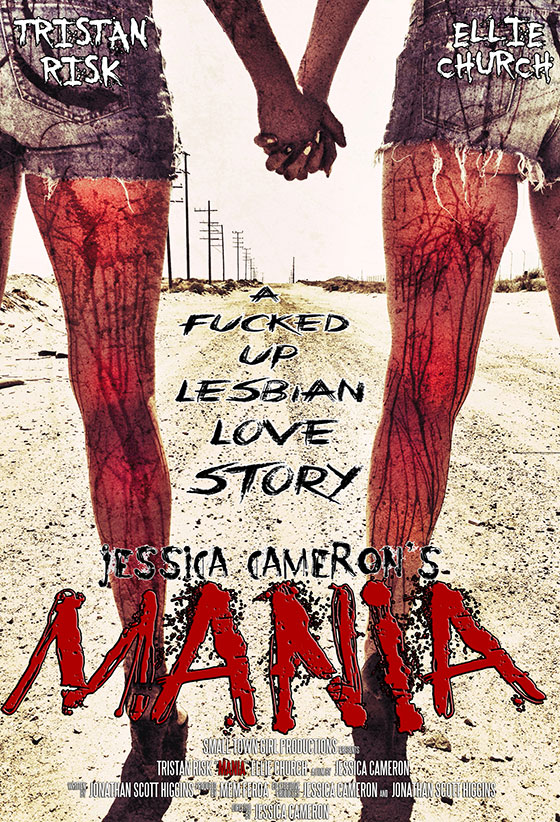
Tristan Risk and Ellie Church are Brooke and Mel
respectively, ie. our lesbian lovers. [NOTE: Considering the lovers’ names,
you’d think we’d be watching more of an irreverent comedy because the pairing
of their monikers seems more than coincidental (uh, reverse the order to get my meaning), but
this isn’t quite a parody of THELMA AND LOUISE. Oh, it gets strangely humorous,
and inappropriately so at times, but it
really ain’t that kind of movie.]
After first sharing via screen text the definition of the
word “mania”, the text disappears and we're left looking at a black screen. As we sit in the darkness, we begin to hear a woman moaning,
eventually revealing that it’s Brooke being orally pleasured by Mel. Then it’s time
for Mel to go to work and before she goes she reminds Brooke to take her pill.
After that, everything goes south.
Basically, Brooke has issues, psychological medical issues,
and she really needs to stay on top of taking her pills. This morning she
perhaps didn’t, then she had some bad work-related news which she was dealing
with poorly, and then she kind of went… cuckoo. And by cuckoo, I don’t mean
Brooke tried to lay her eggs in another women’s nest, I mean she goes all
crackbrained and kills a friend in cold blood with a hammer. Cuckoo. When Mel comes home
and discovers the bloody, pulp-faced carcass in the front hall, the only thing
she can think to do is get rid of the body, grab Brooke and some quickly
packed bags and start running as far away as possible, pronto!
From then on, MANIA becomes a road movie, a road movie where
things just keep going wrong for our two lovers.
I LOVE the simplicity of the set-up.
I was also thrilled to be watching a movie starring both
Tristan Risk and Ellie Church, because they’ve been on my radar after reading
about them in other films, films which I haven’t gotten around to actually seeing. Like,
Tristan Risk is in Jen and Sylvia Soska's’ AMERICAN MARY, and even though I have
that DVD signed by those talented, slyly provocative siblings, I haven’t watched it yet ‘cause…
I’m a dork. Nor have I watched Astron-6’s latest, THE EDITOR, which also has
Ms. Risk in it and I also own a DVD of (again: Dork! Dork!). As for Ellie
Church, I have seen her in "the lost slasher film of the 70s" HEADLESS (uh, I just haven’t finished my review of
it, yet! That’s the one I started last summer…) where I thought she was great
playing an employee working at a roller-skating rink who’s blunt, cynical and
pretty funny. What’s neat was I thought her character in MANIA was distinctly
different from her character in HEADLESS. As Mel, she is, to a degree, naively sincere (especially in these specific circumstances of being in constant "escape mode"), a sort of
idealistic person who makes a “promise to protect” Brooke, the one she loves,
and for that matter, Mel believes in love as well. As the film goes on, this
belief in herself and what she can do to protect Brooke is severely tested.
Besides the impulsive desperation of Mel’s escape strategy,
it’s further complicated by two important facts: 1) Mel’s the only one
apparently competent enough to drive and 2) occasionally Mel needs to stop and
sleep. Normally, the notion of them having to stop mid-flight to points unknown would increase the suspense of being caught, but in this
case, there’s another more pressing problem: when Mel sleeps, either in the car
or in a motel, Brooke conveniently goes into this sort of trance (for lack of a
better word), where she looks awake but her head’s definitely in another
world. Let’s call it Homicidal
Sleepwalking. Specifically, Brooke is motivated by some Praying Mantis/Black
Widow type of manic complex where her brain may be elsewhere but her body is
here and wants to immediately fuck the first strange guy she comes in contact
with (and its definitely “fucking” not the more polite “have sex with”), but in
this case its vigorous spontaneous sex as foreplay
because after she achieves carnal completion, our Ms. Brooke is compelled to
reciprocate the male’s act of penetration with her own, using whatever’s handy which is usually something Sharp, Metal and Stabby (the Divorce Law Firm of…). One of
the more obvious ways both actresses commit to the film are the way they embrace the variety of scenes that require them to be nude or damn near nude, and as Brooke in “assertive date mode”, Tristan Risk is
emphatically unself-conscious about displaying and utilizing her body. Being a guy, I had no problem with this plot
device/character trait. I don’t know what specific clinical mental issue Brooke
had but from an exploitation film perspective, it’s definitely an attention grabber.
Although, actual mental illnesses aside, you could almost formulate a dysfunctional motivation for her impulsive couplings and killings: some
misplaced insecurity/jealousy. As they continue to drive, Brooke asks Mel
pointedly why she became a lesbian knowing she used to date men. After hearing
her explanation, Brooke then asks her how many men she slept with, but Mel won’t
go there. But since these questions come shortly after we witness a Brooke terminal
quickie, you kind of read into these series of questions. There are times when we see them driving at night where the fragmented illumination of oncoming headlights picks out the women’s separate
faces from the darkness and Tristan Risk’s beautiful, staring visage takes on a mask-like
quality, similar to the iconic Barbara Steele, a fascinating, enigmatic quality
which serves her brooding silences well.
Meanwhile, when Mel does get a chance to sleep, she doesn’t
get much rest because she’s tormented by nightmares involving Brooke. On one level, director
Cameron has some fun with these nightmares, dolling Mel up in
increasingly fancy and outrageous fake eyelashes for example. But the nightmare
scenes are also executed to explore moodier, surreal depths, serving up tangible
ways to appreciate Mel’s inner thoughts and fears. Obviously, she’s terrified
of losing Brooke, as she dreams of finding Brooke dead or having committing
suicide, or she’s being physically dragged away from Brooke, etc.
Meanwhile, Brooke’s ongoing impulse to fornicate then
exterminate impromptu sexual partners doesn’t seem to let up. Out of desperation,
Mel frantically tries to distance themselves from the increasing body count by erasing their on-going trail but
she’s also freaking out more and more because she realizes she’s in way over
her head.
The plot takes some sick delight in throwing further
complications at our lovers on the run. When they need to steal a car our
desperately intrepid couple risk searching for the car keys in an unfamiliar house, trying to remain undiscovered even while an increasing number of occupants are still active inside. This sequence
features a simple yet amusingly bizarre cameo by Ellie Church’s real husband,
actor/director Brian Williams. Williams was also in HEADLESS as Church’s
genuinely sleazy boss of the skating rink, but this time he shows us a more
sensitive side by being dressed in drag. During this same sequence, there’s an
ongoing extended sex scene being hammered out not only as visual and aural comic
relief, but also as a way of increasing suspense if the sexual participants happen to take a sudden break and then possibly discover our protagonists searching the
immediate environs by sneaking along the floor dog-style, and then director
Cameron does a smooth bit of injecting further suspense as well.
There are additional developments sprung upon our
anti-heroines, like a mugging by a drifter and a free dinner with unexpected
consequences.
If I had any quibbles, part of me wished the tension could
have been ratcheted up even more at times, and I second-guessed the wisdom of
(somewhat) revealing in advance the intentions of the dinner hostess.
I’ll go a little more into that plus some other thoughts but
that’s going to be a spoiler heavy conversation, so I’ll get to that at the end
of this review.
After Brooke unintentionally (‘cause she’s nutty) but
unequivocally undermines a possible way out of their mess, the film runs
headlong into its conclusion. Earlier I noted the somewhat “misleading”
coincidence of their names, Mel and Brooke. But, in hindsight, perhaps any
“meaning” their two names have because they “go together” has less to do with
the film genre and is more an indication of some twisted star-crossed destiny
of their tragic love (and still a simple but sincere cinematic shout out?). Arguably the couple's earlier nude scenes together may be exploitation film fodder visually speaking, but these risqué moments also show evidence of a gentle, sensual
quality of tangible affection being expressed between the lovers. Before their fateful journey strained their emotional bonds together, their names are sweetly suitable together.
For the most part, the film is a thrilling joyride into shared madness served up well by: our two committed leads (and
interpret that however way you want), Ms. Risk and Ms. Church; a disturbingly
enjoyable plotline from screenwriter Jonathan Scott Higgins; intimate and
creative direction from Jessica Cameron;
consistently sweet looking visuals and lighting from Director of
Photography Josh Chiara (for instance, I LOVED the shots where one of the leads
was in tight close-up on one half of the screen, like Brooke staring at the
camera out the window, and in the other half of the screen in the background
but still in focus was Mel entering full-body into the house and discovering
the first corpse on the floor). Oh! And I also love the graphics of the beginning and end credits.
MANIA was a pretty damn fine exploitation ride! I’m thinking
this would make a suitable double-feature with either the Soska Sisters’ debut
DEAD HOOKER IN A TRUNK or Alexandre Aja’s HIGH TENSION. Hope it does well on
the film festival circuit and I look forward to seeing it again.
Here's the 31 second teaser for MANIA. NOT SAFE FOR WORK! But you'll get a sense of what you're in for.
ALSO: SPECIAL BONUS!
Excellent interview with Jessica Cameron about directing, horror films, and a surprising answer as to what film she would remake if she could and with what dream cast. From the Australian website Cult Projections, which looks pretty cool on its own.
Okay, this is just some additional thoughts/remarks . Part
of this is me talking completely as an armchair/wanna-be filmmaker. Part of
this is just me making additional comments but I feel it would be best saved
for those readers who’ve already seen the film.
1 1. First of all, a really MINOR point. I was
somewhat surprised by the nudity and the amount of it in MANIA (but not
disappointed, in fact most certainly I was delighted) although I wasn’t
complaining (again: nope!). I say surprised because when I saw Jessica
Cameron’s directorial debut, TRUTH OR DARE, there’s a scene where actress
Devanny Pinn comes out wearing a bikini but suddenly she’s like covered up or
removed from the scene. I forget how the scene actually transpired, but I
remember that a point seemed to be made that she needed to cover up. And I
thought, how weird, because I didn’t think Ms. Pinn would be self-conscious
about appearing in a bikini, so I wondered if this was something to attribute
to the director sensibility-wise? Of course, I also wondered if, perhaps, I
remembered this scene completely incorrectly (and I did wish I could watch the
film again just to see if I had the same reaction). But, since seeing TRUTH OR
DARE, in my mind the notion of some sort of “selective puritanism” was attached
to Jessica Cameron’s name because of how I perceived that scene in TRUTH OR
DARE. And I say “selective” because she had no apparent issues with gore,
profanity, etc. back then or now. So, in a (not really) similar way, I also had
John Carpenter “pegged” as a filmmaker who would rather suggest than show
actual gore, based on watching HALLOWEEN, THE FOG and ESCAPE FROM NEW YORK…and
then I saw THE THING. But, getting back to the film at hand, after seeing
MANIA, I was either 1) absolutely wrong about my original perceptions; or 2)
Jessica seriously got over her “hang-ups,“ haha!
I guess this a question for the director if
she happens to read this…
2. When I mentioned my wish for possibly increasing
the tension in the film, I thought there were a couple moments when there was a
specific opportunity to milk a situation for more tension and it didn’t go that
way. First, the mugging scene. I thought that was great, because you think, “Oh
my god, this bastard just stole their money, now what!?” But, the big thing is,
he stole Brooke’s pills, and that’s an even more “Oh, shit!” moment. However, I
think Mel should have been more beside herself and maybe tried to catch the guy
as he ran away. I know he was armed, and maybe
he could have hurt her but I’m thinking she knows for certain what Brooke off medication means. Her attempt to fight
the guy for the pills didn’t have to be successful, but just an illustration of
how Mel is getting further stressed out and hysterical, and if Brooke is the
loose cannon, Mel is now deteriorating out of desperation into conducting her
own dubious actions. But even if she still didn’t try to catch the guy and get
back the pills, I think she should have been a lot more emphatic that they
shouldn’t accept the strange woman’s dinner invitation, out of a need to protect the woman. Then, a strained
conversation between Mel and Brooke on the topic of whether Brooke can be
trusted in society would start to further undermine the doubt Brooke has that
Mel still loves her.
3 3. As stated earlier, immediately after the mugging scene,
we introduce the good Samaritan woman who conveniently discovers they’ve been
mugged mere seconds ago and out of apparent kindness, she offers them a free
meal. It’s a borderline generous and bizarre offer from a stranger, but I’m
thinking Mel is really hesitant to put Brooke in contact with any civilians now
that she’s without meds. But allowing that, I can accept Brooke convincing her
to go because they’re now without money, too, so a free meal is a free meal.
But, aside from that, I think the dinner scene might have worked better NOT
knowing the Samaritan had a secret agenda, specifically NOT seeing her put
something in their wine right away. When Mel is suddenly so sleepy, it might’ve
raised a red flag, but still, as an audience we wouldn’t know for sure. Mostly,
I think we’d be nervous as to what Brooke is going to do to the poor hostess
now that she’s alone with her. When the hostess goes to “get more wine,” we
wouldn’t see her get dressed in the plastic raincoat either. I think showing
Brooke make the discovery of the blood on the refrigerator door and then seeing
what the hostess has for leftovers inside the fridge would be a great discovery
for both her AND the audience. Then, after the gruesome discovery she’s
surprised by the hostess clad in stylish American Psycho Wear ™. Brooke then
continue to kill the woman (“this Samaritan picked the wrong person to help
today!”) and when she wakes up Mel, the revelation that Brooke killed their
hostess would just set Mel off and she lays into Brooke. Brooke could finally
show her the evidence in the fridge, or really, maybe not, maybe Mel finally
just backs off but never believes Brooke’s story so the fight would severely
strain their relationship from then on. Which also further feeds into Brooke’s
imaginings of what she thinks Mel really thinks, which is shown so wonderfully
a few times through the film.
4 4. Okay, part of me wondered, “If they really need
to drive all the time to get as far away as possible from their home (and then
additional victims, too), how badly can Brooke be as a driver?” So, I had the
thought, “Gee, too bad we couldn’t see Mel try to teach Brooke how to drive, “
and then watch where that development took us. Either it blows up in Mel’s face
spectacularly, or it seems to work until Brooke starts taking homicidal detours
as Mel sleeps beside her. But, that’s just me with my mind wandering, me
“what-if?”-ing.
5 5. Also, part of me debates whether Brooke would
kill anybody other than men spontaneously. Murdering the dinner hostess makes sense because of the
context, there’s survival involved, arguably. But, the little kids near the
end, I don’t know. But, dramatically, you do need to up the stakes to motivate
Mel to see the lawyer. Brooke’s “trance” conveniently allows the plot to go in
certain directions. But, this could also be me projecting specific motivations
on who she kills (as I stated earler) when perhaps there really are no
motivations at all. Maybe the first victims happened to be men. She’s simply
extremely dangerous. I simply bring this up as a discussion topic.
6 6. Finally, the ending is really interesting. I predicted to
myself as the film wound down that both of them dying would be the way to wrap this up, a
la Romeo and Juliet. And that indeed happened. But, then Mel comes to and gets up. This threw me. Partly
because of her multiple stab wounds (she survived this?), but mostly because Mel and Brooke didn’t
die together. But, as I thought about
it, especially watching Mel walk off, away from the camera with the end credits starting to roll and descending into the sunrise, it seemed
more appropriate, though not necessarily a “happy ending.”
In fact, perhaps because it ISN’T a happy ending, it seemed appropriate. I mean, it’s a horror story that happens to be a love story, or at least, a story about two lovers. Because I don’t think that the depiction of Mel’s anguish over not knowing what to do anymore during the film is an overt cry by Mel for release from Brooke, it’s simply a cry for some kind of solution for their situation. Mel’s just at her wit’s end. That the lawyer may somehow genuinely help them with their situation is a miracle for Mel. Which of course is immediately torpedoed by Brooke via a hand spade into the lawyer’s heart. The dream sequences we first see Mel have play as terrible nightmares of what Mel first feels she’s up against, the constant possibility of losing Brooke as a lover or losing her to death. But as the film progresses I can see the dreams transforming from Mel’s fears of losing/failing Brooke and turning into Mel’s desperate guilty fantasies of getting out of their terrible, deteriorating situation: if only Brooke would die, if only the responsibility of protecting Brooke was taken out of Mel’s hands by someone else. And that’s an awful thing for Mel to realize she’s subconsciously dreaming about, perhaps after the lawyer’s demise, she’s even consciously hoping for. Okay, maybe this is me over-analyzing a lot, because I didn't really think all this while the end played out. I've been trying to sort out my feelings and articulate them after the fact. It's quite possible I'm really full of shit. But, still I think I could legitimately argue this take on the ending. Brooke and Mel are at their furthest apart emotionally after Brooke kills the lawyer. Mel can't believe she could do that and yells at her and for the first time, Brooke reacts by running away from her. Perhaps realizing what she's done. Mel gives chase but Brooke is long gone. When Mel finally catches up, at a conveniently empty house, Brooke seems to kill her, stabbing her more than once. I wish I could see the film again for this moment because part of me is remembering that Brooke is in her sleepwalking state and that she comes out of it AFTER murdering Mel. But, I could be conveniently misremembering that to fit my half-assed thesis here. Because it seems poetic to me that the now lucid Brooke sees what she's done to Mel, and so she decides to finally end it, and she commits suicide to join Mel (again, so to speak) and also because the thought of living alone is unthinkable. But by committing suicide Brooke does Mel the ultimate (and apparently posthumous) favor of killing herself as well. And I believe this is the only life, her own life, that Brooke consciously takes, all the other victims' deaths (including Mel, I think) are arguably committed while Brooke’s in her sleepwalking state. Sure, Mel could have merely passed out from the shock of being stabbed several times, but in a real way we thought she had actually died. So, when Mel suddenly rises, it's as if she's been resurrected. In fact, it seems that miraculously, Brooke’s self-sacrifice allows Mel to become resurrected. But sadly, Mel may have been more at peace in death. As she rises, she sees Brooke lying next to her on the floor and having committed suicide. As she leaves the house Mel may be arguably free to move on but she also has the lives of all the innocent victims they killed to contemplate. This awful burden is something Mel now has to process for the rest of her life.
In fact, perhaps because it ISN’T a happy ending, it seemed appropriate. I mean, it’s a horror story that happens to be a love story, or at least, a story about two lovers. Because I don’t think that the depiction of Mel’s anguish over not knowing what to do anymore during the film is an overt cry by Mel for release from Brooke, it’s simply a cry for some kind of solution for their situation. Mel’s just at her wit’s end. That the lawyer may somehow genuinely help them with their situation is a miracle for Mel. Which of course is immediately torpedoed by Brooke via a hand spade into the lawyer’s heart. The dream sequences we first see Mel have play as terrible nightmares of what Mel first feels she’s up against, the constant possibility of losing Brooke as a lover or losing her to death. But as the film progresses I can see the dreams transforming from Mel’s fears of losing/failing Brooke and turning into Mel’s desperate guilty fantasies of getting out of their terrible, deteriorating situation: if only Brooke would die, if only the responsibility of protecting Brooke was taken out of Mel’s hands by someone else. And that’s an awful thing for Mel to realize she’s subconsciously dreaming about, perhaps after the lawyer’s demise, she’s even consciously hoping for. Okay, maybe this is me over-analyzing a lot, because I didn't really think all this while the end played out. I've been trying to sort out my feelings and articulate them after the fact. It's quite possible I'm really full of shit. But, still I think I could legitimately argue this take on the ending. Brooke and Mel are at their furthest apart emotionally after Brooke kills the lawyer. Mel can't believe she could do that and yells at her and for the first time, Brooke reacts by running away from her. Perhaps realizing what she's done. Mel gives chase but Brooke is long gone. When Mel finally catches up, at a conveniently empty house, Brooke seems to kill her, stabbing her more than once. I wish I could see the film again for this moment because part of me is remembering that Brooke is in her sleepwalking state and that she comes out of it AFTER murdering Mel. But, I could be conveniently misremembering that to fit my half-assed thesis here. Because it seems poetic to me that the now lucid Brooke sees what she's done to Mel, and so she decides to finally end it, and she commits suicide to join Mel (again, so to speak) and also because the thought of living alone is unthinkable. But by committing suicide Brooke does Mel the ultimate (and apparently posthumous) favor of killing herself as well. And I believe this is the only life, her own life, that Brooke consciously takes, all the other victims' deaths (including Mel, I think) are arguably committed while Brooke’s in her sleepwalking state. Sure, Mel could have merely passed out from the shock of being stabbed several times, but in a real way we thought she had actually died. So, when Mel suddenly rises, it's as if she's been resurrected. In fact, it seems that miraculously, Brooke’s self-sacrifice allows Mel to become resurrected. But sadly, Mel may have been more at peace in death. As she rises, she sees Brooke lying next to her on the floor and having committed suicide. As she leaves the house Mel may be arguably free to move on but she also has the lives of all the innocent victims they killed to contemplate. This awful burden is something Mel now has to process for the rest of her life.
Kind of deep.
And hell, yeah, definitely “fucked up.”
Blog post edited somewhat 4-19-16, 1:46 am (and I may still do some tinkering with it)
And hell, yeah, definitely “fucked up.”
Blog post edited somewhat 4-19-16, 1:46 am (and I may still do some tinkering with it)
Subscribe to:
Posts (Atom)